
The Login Revolution: Why Passkeys Are Replacing Passwords Now: Passwords are slowly disappearing. In their place, passkeys authentication is gaining strong momentum across websites, apps, and devices. Major tech platforms are now encouraging users to switch to this safer login method. Instead of remembering complex passwords, users authenticate with biometrics or device security. As a result, login becomes faster and more secure at the same time.
Why passkeys authentication is replacing passwords
Passwords have many weaknesses. People reuse them. They forget them. Hackers also steal them through phishing attacks. Therefore, the industry needs a better solution. Passkeys authentication removes shared secrets. There is no password stored on a server that can be stolen. Instead, a cryptographic key stays on the user’s device. Because of this design, phishing becomes almost impossible. Attackers cannot trick users into giving away credentials that do not exist.
How passkeys authentication works in simple terms
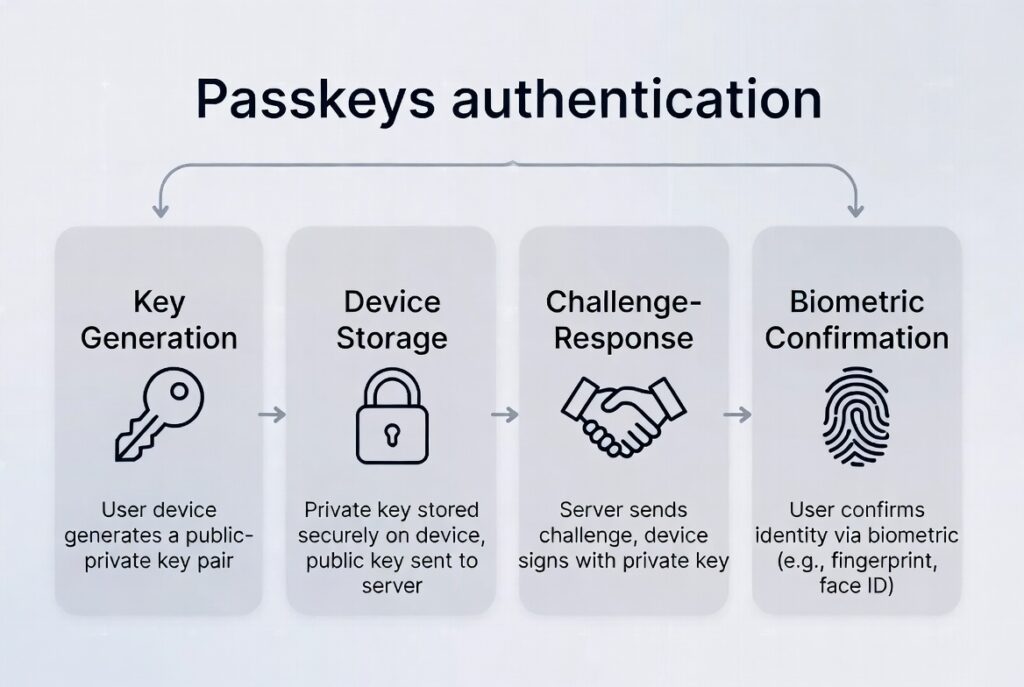
Passkeys use public-key cryptography. When a user signs up, the device creates a key pair. One key stays private on the device. The other is public and stored by the service. During login, the service sends a challenge. The device signs it using the private key. This proves identity without sharing secrets. In addition, users confirm login with biometrics or a device PIN. This adds another layer of protection.
Passkeys authentication and user experience
Security often hurts usability. However, passkeys improve both. Users no longer type long passwords. Instead, they confirm identity with a fingerprint or face scan. This reduces friction. As a result, login success rates increase. Support tickets related to password resets also drop. Moreover, passkeys work across devices through secure sync. This makes adoption easier for everyday users.
Big tech adoption of passkeys authentication
Major platforms are driving this shift. Operating systems, browsers, and cloud services now support passkeys by default. Websites are also joining in. Many login pages now offer passkeys as an option. Over time, passwords may become a backup instead of the primary method. This push is supported by industry standards. The FIDO Alliance and the World Wide Web Consortium promote passwordless authentication across the web, as outlined in their open web authentication standards at w3.org.
Expert view on Passkeys Are Replacing Passwords
Security experts see this as a turning point. One cybersecurity researcher explained:
“Passkeys are the first authentication method that improves security without making life harder for users.”
This balance is important. When security tools are easy to use, adoption increases naturally.
Challenges slowing passkeys authentication adoption
Despite progress, challenges remain. User education is one issue. Many people still do not understand how passkeys work. Some users also worry about losing devices. However, recovery systems exist through secure account sync and identity checks. Another challenge is partial adoption. Some websites support passkeys, while others do not. This inconsistency can confuse users.
Passkeys authentication and broader tech trends
This shift fits into a larger trend toward zero-trust security. Systems now assume breaches can happen. Therefore, they reduce reliance on shared secrets. Hardware security also plays a role. Modern devices include secure enclaves that protect cryptographic keys. This makes passkeys more resilient. In addition, browsers are becoming security platforms, not just viewing tools. Authentication is now a core browser feature.
Business impact of passkeys authentication
For businesses, passwordless login reduces costs. Fewer password resets mean less support overhead. Security incidents also decline. Moreover, customer trust improves. Users feel safer when login is simple and secure. E-commerce and financial platforms benefit the most. Faster login leads to fewer abandoned sessions.
What to expect next for passkeys authentication
In the near future, more websites will default to passkeys. Passwords may be hidden behind advanced options. Governments and enterprises may also adopt passkeys for internal systems. This could reshape enterprise security policies. Over time, passwords may become legacy technology.
Final takeaway
Passkeys authentication represents a major shift in how people log in online. It improves security, reduces friction, and protects users from common attacks.
As adoption grows, the web moves closer to a passwordless future built on trust and simplicity.